Sub-Total: $0.00
Simbolul Rivierei: Henri Negresco și Povestea Hotelului care a Definit o Epocă
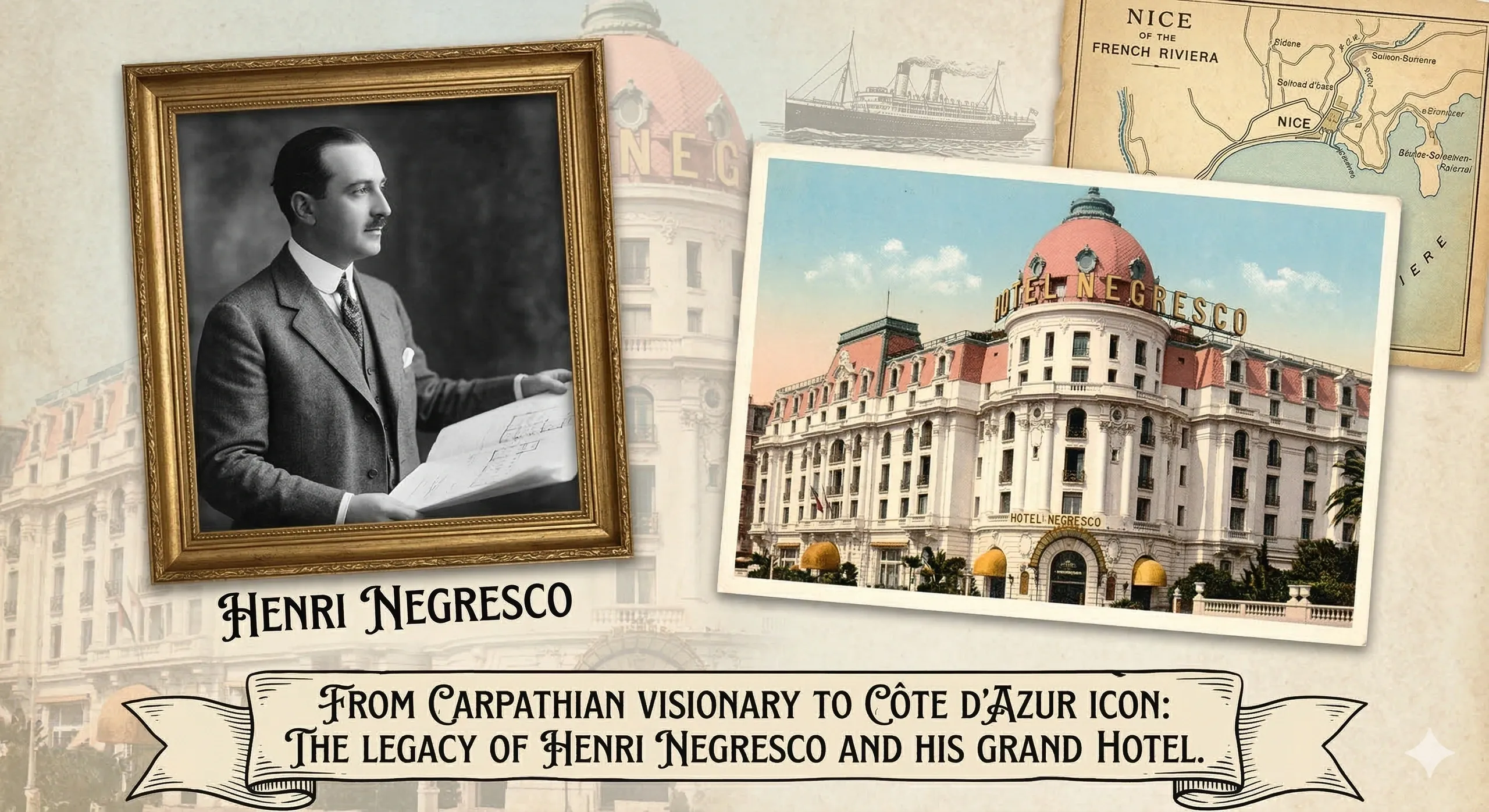
Promenada Englezilor din Nisa este un mozaic format din apele sclipitoare ale Mediteranei, palmieri și arhitectură elegantă. Însă o singură clădire domină peisajul ca o bijuterie a coroanei, cu domul său roz iconic servind drept far al istoriei și al luxului fără egal: Hotel Negresco. Această „mare doamnă” a Coastei de Azur nu este doar un loc de cazare; este un muzeu viu, un testament al unui vis audace și o poveste indisolubil legată de fondatorul său strălucit și vizionar, hotelierul român Henri Negresco.
Astăzi, explorăm straturile acestei instituții legendare, de la originile sale aurite din Belle Époque până la statutul de monument cultural, asigurându-ne că povestea remarcabilă a creatorului său primește atenția cuvenită.
Vizionarul din Carpați și „Palatul Palatelor”
Hotelul Negresco poartă numele lui Henri Negresco, născut în România la sfârșitul secolului al XIX-lea. Negresco nu a fost un aristocrat și nici nu a moștenit o avere colosală. A fost ceea ce numim astăzi un om care s-a ridicat prin forțe proprii (self-made man), mânat de o viziune clară și o etică a muncii incredibilă. Și-a început cariera în București, acumulând rapid experiență în industria ospitalității, înainte de a se aventura spre marile hoteluri din Londra și Paris.
În Nisa, Henri Negresco și-a găsit adevărata vocație. Recunoscând potențialul Coastei de Azur de a deveni o destinație de iarnă de talie mondială pentru elita europeană și rusă, el și-a imaginat crearea nu a unui simplu hotel, ci a unui „Palat al Palatelor” — un etalon al serviciilor impecabile, al artei și al inovației moderne.
Visul său a necesitat un arhitect pe măsură. L-a găsit în persoana lui Édouard Niermans, cel care proiectase locații legendare precum Moulin Rouge. Împreună, și cu un sprijin financiar semnificativ din partea unor parteneri influenți, Henri Negresco și-a realizat capodopera.
Construcția în sine a fost un spectacol, utilizând o structură revoluționară din beton armat. Elementul său definitoriu a fost însă estetica: magnificul candelabru din cristal Baccarat și vastul Salon Royal cu dom de sticlă, proiectat special pentru a găzdui imensele baloane cu aer cald ale epocii.
Triumful din Belle Époque
Hotelul Negresco și-a deschis porțile pe 4 ianuarie 1913, cu o gală grandioasă la care au participat capete încoronate, magnați și personalități culturale. A fost un triumf instantaneu. Regi, regine, arhiduci și artiști s-au grăbit să îi treacă pragul, atrași nu doar de decorul opulent, ci și de atenția imaculată la detalii pe care Henri Negresco o supraveghea personal. El nu doar conducea hotelul; el întruchipa ospitalitatea acestuia.
Aceasta a fost epoca de aur a călătoriilor de tip „Grand Tour”, iar Henri Negresco se afla în epicentrul ei, stabilimentul său fiind simbolul unei lumi care se simțea optimistă, bogată și permanentă.
Tragedia și o Renaștere Remarcabilă
Izbucnirea Primului Război Mondial în 1914 a pus capăt acestei ere glorioase. Elita europeană s-a retras, iar Coasta de Azur a devenit un loc al incertitudinii. Tragedia l-a lovit direct pe Negresco: cu inima frântă de război și de pierderea clientelei sale, Henri Negresco s-a stins din viață în 1920, la Paris.
Magnificul său hotel a fost rechiziționat și transformat în spital, holurile sale aurite răsunând de un cu totul alt tip de sunete. După război, hotelul s-a confruntat cu mari dificultăți financiare, viitorul său părând sumbru.
Salvarea a venit în 1957, când Hotelul Negresco a fost preluat de dinamica Jeanne Augier și soțul ei. Jeanne Augier, o colecționară pasionată de artă și istorie, a făcut mai mult decât să restaureze hotelul; l-a transformat într-o operă de artă în sine. Ea a instalat piese ce reprezintă cinci secole de istorie franceză — de la tapiserii renascentiste la capodopere contemporane de César sau Niki de Saint Phalle. Timp de peste 50 de ani, până la moartea sa în 2019, Madame Augier a fost inima hotelului.
Negresco în Literatură și Film
Atmosfera unică a hotelului l-a transformat într-un decor irezistibil pentru scriitori. Poate cea mai faimoasă apariție a sa este în clasicul thriller din 1971 al lui Frederick Forsyth, The Day of the Jackal (Ziua Șacalului).
În acest roman captivant, „Șacalul”, un asasin meticulos și nemilos, se cazează la Hotel Negresco ca parte a planului său elaborat. Descrierile detaliate ale ambianței hotelului — serviciile, grandoarea și natura sa discretă — adaugă o textură bogată narațiunii, legând pentru totdeauna numele Negresco de ideea de intrigă, lux și suspans.
Negresco Astăzi: Mai Mult Decât un Hotel
Astăzi, Hotelul Negresco rămâne o instituție de cinci stele pe Promenada Englezilor, fiind totodată complet unic. Nu este un muzeu despre un hotel, ci un muzeu care este un hotel. Nu doar admiri arta de pe pereți; ești înconjurat de ea.
Clădirea rămâne un testament pentru două viziuni puternice: cea a fondatorului român, Henri Negresco, care a visat imposibilul, și cea a lui Jeanne Augier, care a înțeles că acesta poate fi și mai măreț. Când pășiți sub domul roz și auziți istoria șoptind prin holuri, nu experimentați doar o simplă ședere; pășiți într-o poveste profundă și strălucitoare a excelenței franceze cu rădăcini românești.
Cartea de oaspeți a Hotelului Negresco arată ca un veritabil „Who’s Who” al secolelor XX și XXI. Deoarece Henri Negresco a construit „Palatul Palatelor”, iar Jeanne Augier l-a umplut ulterior cu artă de talie mondială, acesta a devenit reședința naturală pentru familii regale, staruri de la Hollywood și legende ale muzicii.
Iată câteva dintre cele mai faimoase personalități care au pășit pe holurile sale pline de istorie:
Royalty and World Leaders
- Queen Elizabeth II: The British monarch stayed at the hotel, adding to its prestige as a destination for reigning royalty.
- The Duke and Duchess of Windsor: Following his abdication, Edward VIII and Wallis Simpson were frequent visitors to the Côte d’Azur and the Negresco.
- Winston Churchill: The British Prime Minister was a lover of the French Riviera and found the discretion of the Negresco to his liking.
- The Shah of Iran: Before the revolution, the Iranian royal family were regulars during the summer seasons.
Icons of the Silver Screen
- Grace Kelly & Prince Rainier: Even before she became the Princess of Monaco, Kelly was a symbol of the elegance the Negresco represented.
- Marlon Brando: The legendary actor was known to appreciate the hotel’s blend of luxury and privacy.
- Cary Grant: The epitome of Hollywood style, Grant was a natural fit for the Promenade des Anglais’ most stylish building.
- Clint Eastwood: A frequent guest during his visits to the south of France for film festivals and leisure.
Music and Arts
- The Beatles: In 1964, at the height of Beatlemania, the “Fab Four” stayed at the Negresco. It was here, in one of the suites, that John Lennon and Paul McCartney reportedly finished writing Can’t Buy Me Love on a piano brought to their room.
- Salvador Dalí: The surrealist master was perhaps the hotel’s most eccentric guest. He was famously known for walking through the lobby with his pet cheetah on a leash.
- Pablo Picasso: A neighbor in the south of France, Picasso was a frequent visitor and friend of the hotel’s management.
- Elton John: A long-time lover of Nice (where he owns a villa), Sir Elton has been a frequent patron of the hotel’s world-class dining and hospitality.
Modern Icons
- Michael Jackson: The King of Pop stayed in the imperial suites during his world tours.
- Frank Sinatra: “Ol’ Blue Eyes” brought his signature Rat Pack glamour to the Negresco’s bars and lounges.
The hotel continues to host the elite of today, from Formula 1 drivers during the Monaco Grand Prix to tech moguls and world-renowned artists.
The Symbol of the Riviera: Henri Negresco and the Story of the Hotel that Defined an Era
The Promenade des Anglais in Nice is a tapestry of sparkling blue Mediterranean water, palm trees, and elegant architecture. But one building stands as a crowning jewel, its iconic pink dome a beacon of history and unparalleled luxury: the Hotel Negresco. This grand dame of the Côte d’Azur isn’t just a place to sleep; it’s a living museum, a testament to an audacious dream, and a story inextricably linked to its brilliant, tragic founder, the Romanian hotelier Henri Negresco.
Today, we peel back the layers of this legendary institution, from its gilded Belle Époque origins to its status as a cultural monument, ensuring the remarkable story of its creator receives its proper emphasis.
The Romanian Dreamer and the “Palace of Palaces”
The Hotel Negresco is named after Henri Negresco, born in Romania in the late 19th century. Negresco wasn’t an aristocrat or an inheritor of vast wealth. He was, in modern parlance, a “self-made man,” driven by a vision and an incredible work ethic. Starting his career in the Romanian capital, Bucharest, he quickly gained experience in the hospitality industry before venturing to Europe’s grandes dames in London and Paris.
In Nice, Henri Negresco found his true calling. Recognizing the potential of the blossoming Côte d’Azur as a world-class winter destination for the European and Russian elite, he envisioned creating not just a hotel, but the “Palace of Palaces”—a beacon of unparalleled service, stunning art, and modern innovation that would attract the titans of industry and aristocracy.
His dream required an architect as visionary as himself. He found him in Édouard Niermans, the designer of legendary Parisian venues like the Moulin Rouge. Together, and with significant financial backing from influential partners (many of whom he met while running famous establishments in Paris and Nice, like the Municipal Casino and the Ciro’s restaurant), Henri Negresco realized his masterpiece.
The construction itself was a spectacle, utilizing a groundbreaking reinforced concrete structure. Its defining feature, however, was its aesthetics: the magnificent pink Baccarat crystal chandelier and the vast glass-domed Salon Royal (also designed by Niermans), designed specifically to accommodate the era’s massive hot-air balloons.
The Belle Époque Triumph
The Hotel Negresco opened its doors on January 4, 1913, with a grand gala attended by crowned heads, business tycoons, and cultural luminaries. It was an instant triumph. Kings, queens, archdukes, and artists flocked to its doors, drawn not just by the opulent setting but by the immaculate attention to detail that Henri Negresco personally supervised. He didn’t just manage the hotel; he embodied its hospitality.
This was the golden age of “Grand Tour” travel, and Henri Negresco was at its epicenter, his establishment a symbol of a world that felt optimistic, opulent, and permanent.
Tragedy and a Remarkable Rebirth
The eruption of World War I in 1914 brought this glorious era to a shattering end. The European elite retreated, and the Côte d’Azur became a place of uncertainty. Tragedy struck the Negresco personally: Henri Negresco, heartbroken by the war and the loss of his clientele, passed away in 1920.
His magnificent hotel was requisitioned as a hospital, its gilded halls echoing with a far different sort of noise. Following the war, the hotel struggled financially, its future looking bleak.
It was in 1957 that the Hotel Negresco found its second savior in the dynamic Jeanne Augier and her husband. Jeanne Augier, a collector and passionate lover of art and history, did more than restore the hotel; she transformed it into a masterpiece of its own.
Recognizing that the standard “gilded age” look was no longer enough, Augier made the Negresco a living museum. She purchased and installed pieces of art representing five centuries of French history—from Renaissance tapestries to contemporary masterpieces by César and Niki de Saint Phalle. She designed each room individually, ensuring every space had its own distinct soul. For over 50 years, until her passing in 2019, Madame Augier was the heart and soul of the hotel, her unwavering vision cementing its reputation as a unique cultural destination.
The Negresco in Literature and Film
The Hotel Negresco’s unique atmosphere and historical significance have made it a irresistible setting for storytellers. It features in countless works of literature, memoirs, and films, but perhaps its most famous appearance is in the classic 1971 novel by Frederick Forsyth, The Day of the Jackal.
In this gripping thriller, the “Jackal,” a meticulous and ruthless assassin, checks into the Hotel Negresco as part of his elaborate plan. The detailed descriptions of the hotel’s ambiance—its service, its grandeur, and its discreet nature—add a layer of rich, believable texture to the narrative, forever linking the Negresco in readers’ minds with intrigue, luxury, and suspense.
The Negresco Today: More Than Just a Hotel
Today, the Hotel Negresco remains a five-star institution on the Promenade des Anglais, yet it’s entirely unique. It isn’t a museum of a hotel, but a museum that is a hotel. You don’t just admire the art on the walls; you are surrounded by it, living with it.
It stands as a testament to two powerful visions: that of its Romanian founder, Henri Negresco, who dreamed the impossible, and that of Jeanne Augier, who realized it could be even greater. When you walk beneath its pink dome and hear the history whispering through its halls, you are experiencing more than a stay; you are stepping into a profound, brilliant, and tragic story of French (and Romanian) excellence.
Royalty and World Leaders
- Queen Elizabeth II: The British monarch stayed at the hotel, adding to its prestige as a destination for reigning royalty.
- The Duke and Duchess of Windsor: Following his abdication, Edward VIII and Wallis Simpson were frequent visitors to the Côte d’Azur and the Negresco.
- Winston Churchill: The British Prime Minister was a lover of the French Riviera and found the discretion of the Negresco to his liking.
- The Shah of Iran: Before the revolution, the Iranian royal family were regulars during the summer seasons.
Icons of the Silver Screen
- Grace Kelly & Prince Rainier: Even before she became the Princess of Monaco, Kelly was a symbol of the elegance the Negresco represented.
- Marlon Brando: The legendary actor was known to appreciate the hotel’s blend of luxury and privacy.
- Cary Grant: The epitome of Hollywood style, Grant was a natural fit for the Promenade des Anglais’ most stylish building.
- Clint Eastwood: A frequent guest during his visits to the south of France for film festivals and leisure.
Music and Arts
- The Beatles: In 1964, at the height of Beatlemania, the “Fab Four” stayed at the Negresco. It was here, in one of the suites, that John Lennon and Paul McCartney reportedly finished writing Can’t Buy Me Love on a piano brought to their room.
- Salvador Dalí: The surrealist master was perhaps the hotel’s most eccentric guest. He was famously known for walking through the lobby with his pet cheetah on a leash.
- Pablo Picasso: A neighbor in the south of France, Picasso was a frequent visitor and friend of the hotel’s management.
- Elton John: A long-time lover of Nice (where he owns a villa), Sir Elton has been a frequent patron of the hotel’s world-class dining and hospitality.
Modern Icons
- Michael Jackson: The King of Pop stayed in the imperial suites during his world tours.
- Frank Sinatra: “Ol’ Blue Eyes” brought his signature Rat Pack glamour to the Negresco’s bars and lounges.
The hotel continues to host the elite of today, from Formula 1 drivers during the Monaco Grand Prix to tech moguls and world-renowned artists.